
The Automated Palletizing Buyer’s Guide
A step-by-step approach to selecting the right palletizing solution for your business. It offers a structured decision-making process along with practical tools to assist you in making a smart choice.
Content
The Automated Palletizing Buyer’s Guide covers these topics:
- Understand what’s on the market
Get an overview of the palletizing solution landscape. - Avoid common pitfalls
Learn about the most frequent mistakes businesses make when choosing a palletizing system. - Evaluate products
Compare solutions efficiently—with an eye on budget and ROI—by looking at initial investments, operating costs, and scalability implications for each solution.
Tools
When you’re looking for a palletizing solution, there are three big questions to answer. The guide includes several customizable tools to help you figure them out.
- Palletizing Solution Comparison Table
Which type of solution meets your needs?
Compare the pros and cons of palletizing with conventional robots, collaborative robots, and manual labor. - Business Alignment Matrix
Does it address your business objectives?
See how well each solution helps solve certain business challenges, so you can decide what to prioritize. - Palletizing Specs Table
What else do you need to know before you buy?
Gather detailed info on each of the products you’re considering, to evaluate which solution is right for your business.
The Automated Palletizing Buyer’s Guide
A step-by-step approach to selecting the right palletizing solution for your business. It offers a structured decision-making process along with practical tools to assist you in making a smart choice.
Chances are that selecting an automated palletizing solution is not something you do regularly. Perhaps this level of investment is new for your business. Or maybe you are getting confused with the myriad of solutions and claims out there, and you need an organized way to make sense of it all.
Then this guide is for you!
We’re pleased to offer you a structured decision-making process for selecting a palletizing solution. In this guide, we draw upon our years of experience to create a step-by-step process and the tools necessary to enable your decision. This process covers specifications, options, and solutions that you should explore during your research to arrive at the right decision for you and your company.
Over 90% of the world’s goods rely on pallet transportation, making your palletizing process more crucial than ever. Your palletizing stations are the lifeline connecting your goods to your customers. However, our industry faces challenges, including high job turnover rates of up to 50% and a projected labor deficit of over 10% by 2030.
The scarcity of available labor, especially affecting palletizing stations, is such a tough challenge businesses are grappling with today and won’t resolve itself anytime soon. Wasting monotonous, laborious, and hazardous non-value-added work on scarce labor is not an effective strategy; it’s a counterproductive management approach.
In this new reality, investing in an automated palletizing solution is a strategic imperative. By integrating automated palletizing solutions into your end-of-line processes, you unlock a future where empowered individuals work alongside advanced automation, enhancing productivity and fostering adaptability. Moreover, studies reveal that 74% of warehouse workers prefer employers providing modern devices like robots to enhance their tasks.
At Robotiq, a pioneering force in collaborative robotics, we’ve empowered robotic arms with purpose and efficiency. Our LEAN ROBOTICS methodology, recognized worldwide, is instrumental in seamlessly transforming how work is done, from machine feeding to assembly, and from picking to packing.
By having assisted tens of thousands of manufacturers in their automation journey, we stand as your experienced partner in addressing your toughest production and logistics challenges.
This buyer guide isn’t a mere product pitch; it’s a knowledge-sharing resource. We’re dedicated to helping you find the best automated palletizing solution for your operations, even if it’s not with us. Our goal is to provide insights for you and your team to assess various options and pinpoint what’s essential for your success.
If our solution aligns with your needs, our team is ready to make your project a success. If not, we’re happy to have assisted you in making the right choice, avoiding wasted time on an ill-fitting solution.
Now is the opportune moment to transform and modernize this vital business function, given the challenges we face.
Time to embrace a future defined by operational excellence & agility, focusing on People, Productivity, and Adaptability.
Join us in adopting the LEAN ROBOTICS methodology, guiding us through the Design, Integration, and Operation steps, toward practical yet groundbreaking

Today companies face many challenges, including persistent job vacancies, supply chain instability, and evolving consumer behaviors. The aftermath of the pandemic changed commercial behaviors and affected labor availability. This left the manufacturing sector struggling with low job retention and fill rates. It is no surprise that people are not interested in repetitive, low-skill jobs. Automation, particularly in injury-prone tasks like palletizing, is an indispensable solution for any business.
The consumer expects a customized product experience. This requires businesses to shift away from high-volume, low-mix (HVLM) manufacturing. In addition to product demand changes, consumers are more conscious of their environmental impact and expect packaging to change to eco-friendly options. These changes in consumer demand are happening more frequently. Businesses are now looking for flexible automation options to meet those changes.
However, the market for automated palletizing solutions is fragmented, and navigating the myriad of information available can be confusing. This guide and comprehensive tools were developed to help anyone considering palletizing automation.
This Buyers Guide is a top-down approach to selecting the right palletizing solution for a business. Before jumping into a technical review of specific products or solutions, it is essential to document the strategic needs of the business. The process starts with the Strategic Imperative Framework, a high-level outline of the business challenges and opportunities.
The Strategic Imperative Framework
The Strategic Imperative Framework stems from the Lean Robotics methodology whose purpose is to:
EMPOWER PEOPLE, BOOST PRODUCTIVITY, AND FOSTER ADAPTABILITY ON THE FACTORY FLOOR
MAXIMIZE AUTOMATION IMPACT THROUGH EFFICIENT DEPLOYMENT PHASED IN DESIGN, INTEGRATE, & OPERATE.
WHY
| PEOPLE | Having a focus on People creates a work environment that values safety, job satisfaction, and growth opportunities. This approach not only improves your operational efficiency and product quality but also builds a more resilient and satisfied workforce, ready to meet the challenges of today and tomorrow. |
| PRODUCTIVITY | Enhancing Productivity is fundamental to bridging the gap between production efficiency and customer satisfaction, directly impacting profitability and brand image. Streamlining operations eliminates manual bottlenecks, significantly boosting throughput while maintaining product consistency. |
| ADAPTABILITY | Adaptability is key to meeting customer needs and grabbing new opportunities. This means being ready to handle different product sizes or orders without big delays or needing outside help. It also means being able to grow your operations when demand spikes, making sure your investments pay off quickly. By focusing on being adaptable, businesses can stay competitive and see real benefits to their bottom line, ready for whatever comes next. |
.png?width=243&height=74&name=Lean-Robotics-Lines-2-Logo%20(1).png)
HOW
| DESIGN | When considering a solution Design, focus on modular and configurable elements that cater to common operational needs, avoiding the complexities and costs of custom engineering. This approach not only facilitates a smoother transition to automation but also future-proofs your operations, allowing for easy adjustments as your business grows and market demands evolve. Emphasizing adaptability, efficiency, and ease of use in design will position your business for sustainable success and agility in a rapidly changing landscape. |
| INTEGRATE | Integrate solutions by focusing on quick deployment, leveraging standardized, modular designs that can be installed and operational within days, not weeks. Choose systems that complement your current processes and layout, avoiding solutions that necessitate extensive modifications or could introduce bottlenecks. |
| OPERATE | Choosing to Operate a reliable and adaptable solution with a proven global track record is key. This approach maintains operational control, ensuring your team can manage and adapt the system without becoming overly reliant on external support, thus avoiding replacing one form of dependency with another. |
The goal of the Strategic Imperative Framework is to provide an understanding of those key strategic factors that decision-makers need to consider in the selection process.
This Framework is designed to be a thought-provoking process. It should be completed by a group of stakeholders as opposed to a single person. A group of 3-5 people covering the different aspects of automating that task (process, engineering, maintenance, people, finance) will ensure that all elements are considered during the evaluation and that a decision gets made.
To simplify the Framework, the table on the next page summarizes the subsection within each category.
How important are these?
| Health & safety | Increase palletizing safety and reduce health risks. |
|
| PEOPLE | Labor availability | Reduce dependency on manual labor for hard-to-fill roles. |
| Employee engagement | Increase employee growth and retention. | |
| PRODUCTIVITY | Efficiency & throughput | Increase throughput and prevent bottlenecks. |
| Consistency | Increase pallet integrity and consistency | |
| Continuity | Reduce downtime and reduce dependency on a few operators. | |
| ADAPTABILITY | Flexibility | Meet cycle-time needs of the value stream in real time; reduce changeover time and complexity. |
| Scalability | Manage fluctuating demands, react to growth, and meet ROI. |
| Pre-engineered precision | Reduce design costs, prevent scope creep, and reduce risks associated with customengineered designs. | |
| PEOPLE | Maximized performance | Maximize payload and pick rate. Decrease footprint. |
| Turnkey solution | Reduce selection and installation complexity. | |
| PRODUCTIVITY | Fast installation | Reduce system install and training time. |
| Factory fit | Minimize impact to factory layout; minimize rearranging upstream and downstream operations. |
|
| ADAPTABILITY | Reliability | Increase production uptime and reduce unplanned downtime. |
| Control | Maintain control of product handling, increase software useability, and modify programs autonomously. |
Considering the business challenges to solve with automated palletizing, this chart can be used to score the importance of each element from 1 (Highest Priority) to 5 (Lowest Priority). It will be used as a reference throughout the selection process.
Spending time at this step is encouraged to align the decision process in the right strategic direction. Once completed and memorized, the Strategic Imperative Framework will be put aside (temporarily). The next chapter presents the different solution categories available on the market that factories may encounter in their search for solutions. The business priority and solution landscape will then come together in later chapters.
NOTE : A low ranking does not indicate an indifference to a particular element. While all elements are important, some businesses may need the palletizer to provide solutions in a particular category. For example, if a business has a robust Environment, Health, and Safety (EHS) program and ranks Health & Safety a 5 (least important), they have confidence in their EHS infrastructure and do not need the palletizing option to solve a Health & Safety risk. Alternatively, if a business ranks this as a 1 (most important), this business is indicating a current risk that the palletizing solution needs to mitigate.
A critical step is understanding what is available in the market today. Selecting an option without considering the landscape of available solutions may eliminate viable options. It is important to undertake this step before delving into any one solution. This chapter will provide an organized overview of solution categories to jumpstart the research process.
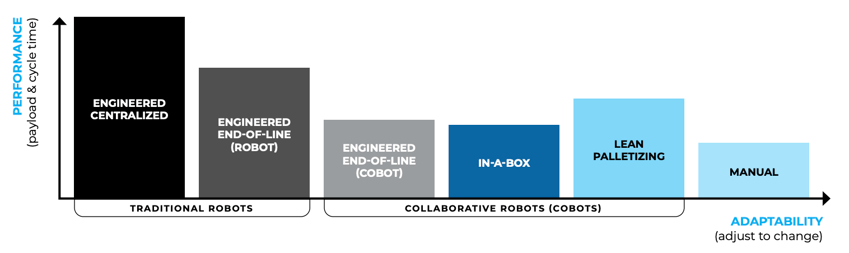
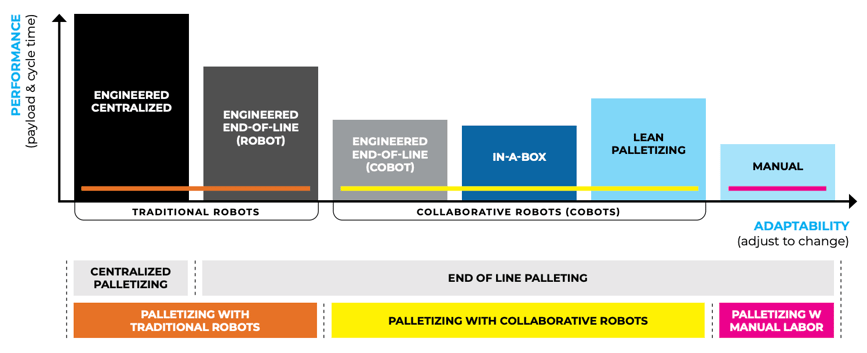
Solution categories start at “Engineered Centralized" (a fenced-off, largescale traditional robot) to “Manual Palletizing”. As one would expect, the categories in the middle are more nuanced. This chapter will touch on those differences. You can also download the automated palletizing solution landscape sheet for an overview of options synthesized in this chapter.
Zero-sum automation: Is there a clear win with automation?
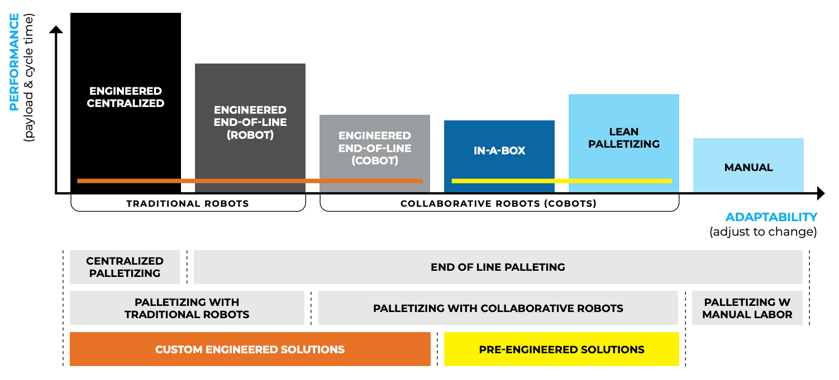
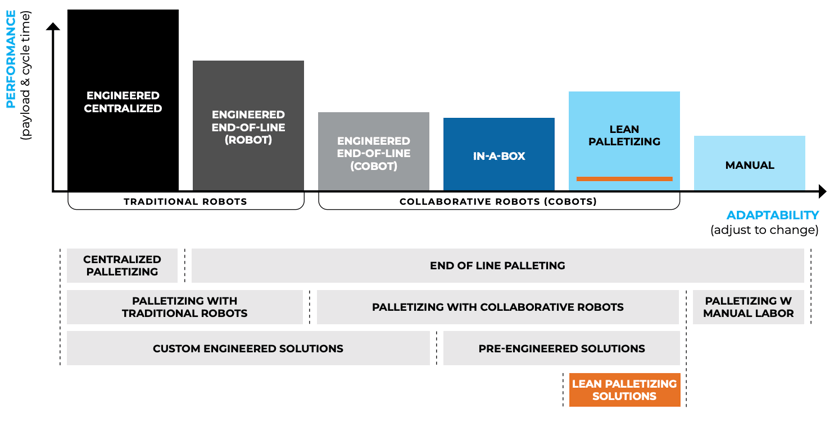
The vast majority of investments in palletizing are aimed at eliminating the reliance on manual labor for this repetitive, strained, and ergonomically unfriendly work. As seen in the graph below, manual palletizing provides the highest level of adaptability (assuming that labor scarcity is not a constraint).
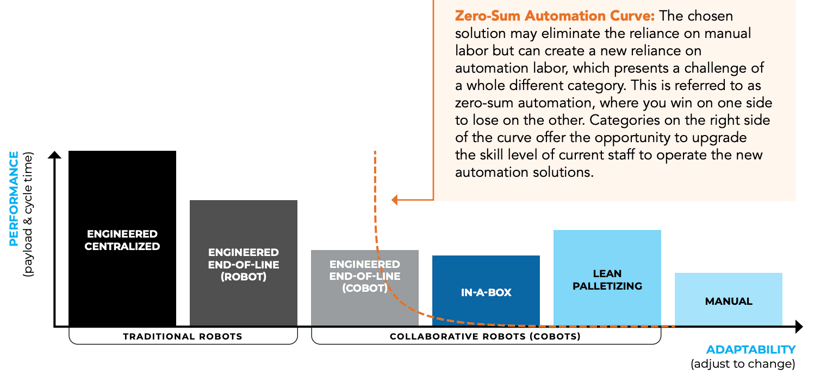
However, the tradeoff is that the fullyautomation choice, while eliminating the reliance on unskilled manual labor, will create a new reliance on highly-skilled labor. Instead of solving the labor shortage problem, it exchanges one shortage for another.
This is the zero-sum automation trade-off: eliminating the reliance on manual labor results in reliance on highly-skilled labor.
However, a palletizing automation decision does not have to be subject to the zerosum automation trade-off, nor does it have to be a choice between productivity and adaptability.
The graphic also includes a zero-sum automation curve, represented by the dotted line.
The two categories on the left side are the most likely to experience the zerosum automation tradeoff, meaning that they require specialized skilled automation labor either in-house or sourced externally. People with these skills are in high demand and may draw companies into a challenge of scarcity and high turnover, within the staff and with external service providers.
Categories on the right side of the curve offer the opportunity to upgrade the skill level of current staff to operate the new automation solutions.
The palletizing landscape can be explained by defining and comparing the following characteristics:
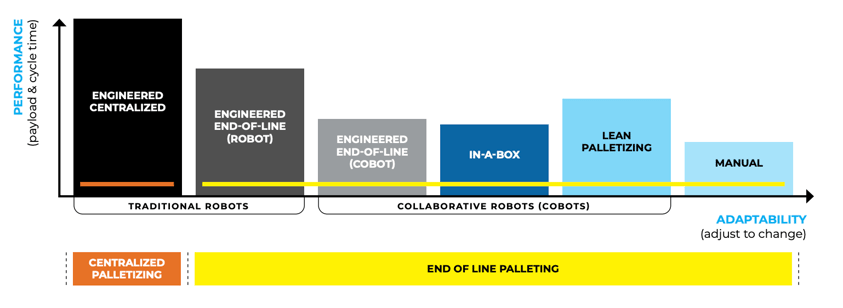
1. Centralized vs End-Of-Line palletizing
2. Palletizing with traditional robots, collaborative robots, or manual labor
3. Custom Engineered vs Pre-Engineered palletizing solutions
4. Lean Palletizing solutions
Centralized vs End-Of-Line palletizing
CENTRALIZED PALLETIZING
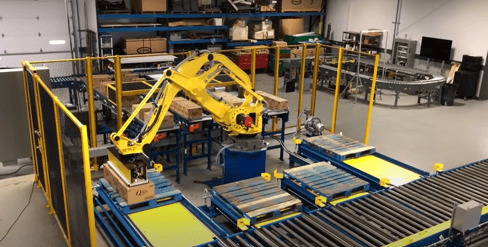
Centralized Palletizing systems stand out for their ability to handle large volumes and high payload at high speeds from multiple production lines. Various lines of conveyors are routed to a central location where the palletizer works. These systems are strategically placed to manage large volumes of standard products (i.e. soft drink bottling), with high speed and precision. However, they come with significant initial investment costs. Centralized palletizers can act as a “monument” within the factory, setting requirements and imposing limitations on the larger factory layout and systems. This can dictate the flow of production and restrict future modifications or expansions of the facility. Their complexity necessitates highly skilled staff for operation and maintenance. Being a single system, they risk entire production line disruptions due to malfunctions.
END-OF-LINE PALLETIZING
End-Of-Line Palletizing systems offer flexibility, adaptability, and scalability. These systems are integrated at the end of each production line. This approach is less complex, requires lower initial investment, and is adaptable. While offering direct control and easier adjustments, these systems have lower throughput efficiency compared to centralized systems. These systems can lead to equipment redundancy in facilities with multiple similar lines and require additional space, impacting overall floor space efficiency.
When choosing between systems, manufacturers must consider their needs and constraints.
|
CENTRALIZED Suitable for operations with high-volume, standard product flows. Require a higher initial investment and offer less flexibility. Can become a single point of failure |
|
|
END-OF-LINE More adaptable and resilient Cost effective Less scalable if wrong platform is chosen initially |
-2.jpg?width=559&height=314&name=Robotiq%20Background%20(Cascade%20Coffee)-2.jpg) |
Palletizing with traditional robots, collaborative robots, or manual labor
PALLETIZING WITH TRADITIONAL ROBOTS
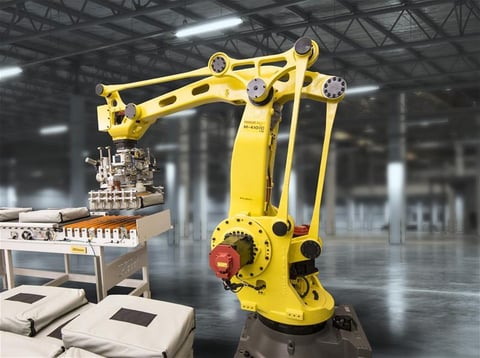
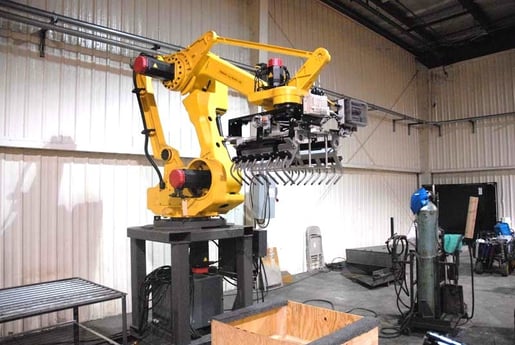
Traditional industrial robots represent the traditional choice for high-speed, high-volume palletizing tasks. These large, stationary systems operate in dedicated spaces away from human workers for safety. They excel in handling large volumes and can manage heavier loads, offering durability and reliability for continuous operation.
However, these robots require significant initial investment. Their limited flexibility, extensive space requirements, and complex maintenance requirements are notable drawbacks. These systems necessitate specialized staff for operation and maintenance, and their immobility and impact on your existing floor layout within the factory can be a constraint.
PALLETIZING WITH COLLABORATIVE ROBOTS (COBOTS)
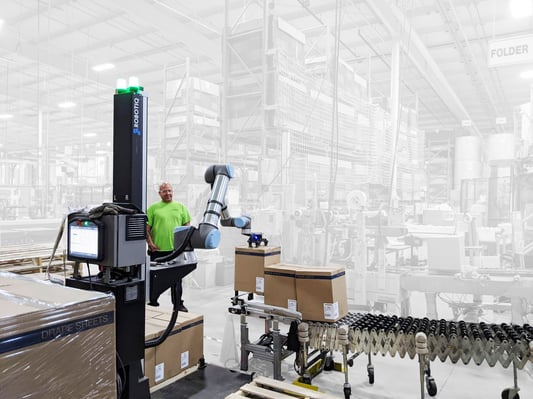
Collaborative robots, or cobots, are designed to coexist with human workers. Smaller, more adaptable, and user-friendly than traditional robots, cobots are suitable for a wide range of applications. They offer flexibility and adaptability, being easily reprogrammable for different tasks. Their design allows for safe human coexistence without extensive safety barriers. Cobot systems are typically more affordable and space-efficient than traditional robots. Cobots can be quickly deployed and integrated into existing workflows, with intuitive interfaces that are easy to use. However, they generally have lower payload capacities and speed.
PALLETIZING WITH MANUAL LABOR
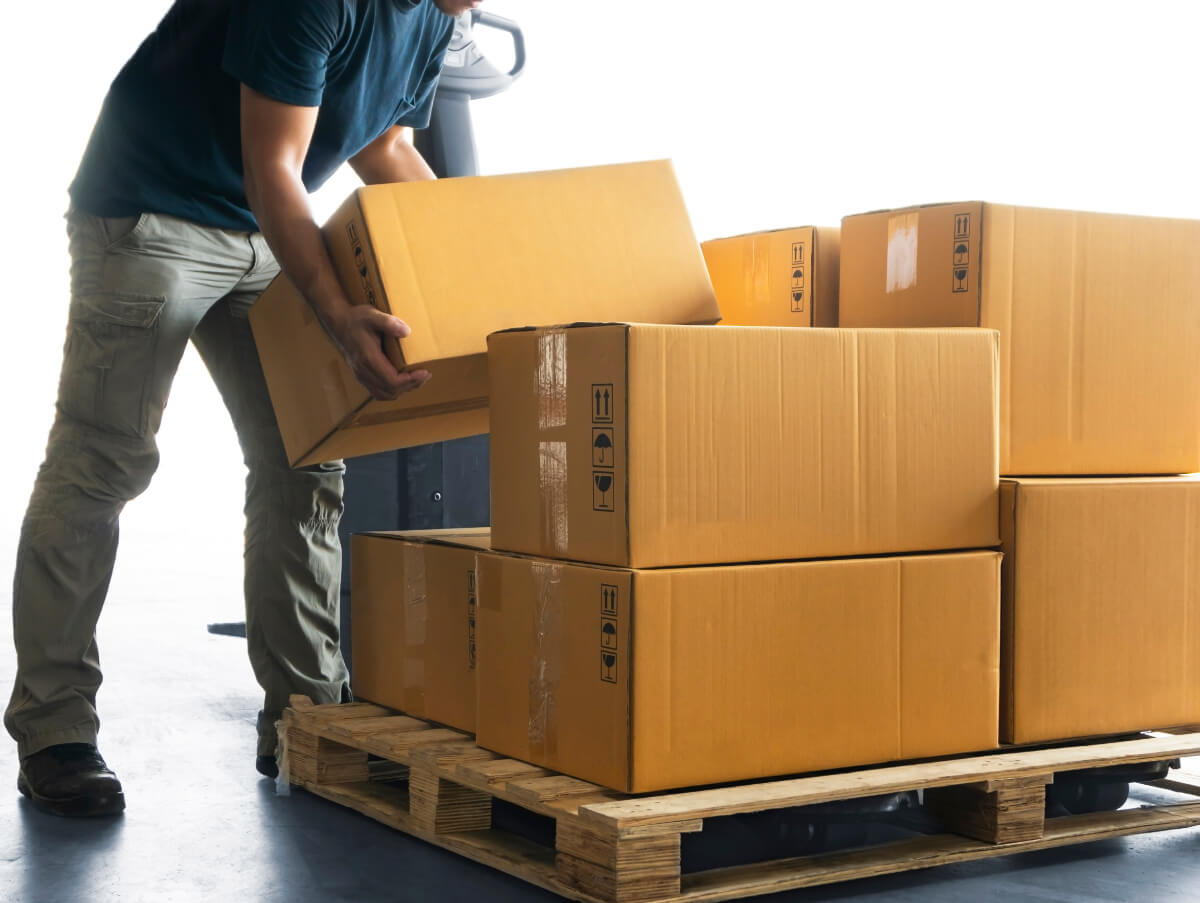
Manual labor in palletizing involves human workers handling and stacking products. This method offers high flexibility, allowing quick adaptation to different product types and sizes. It also requires minimal initial investment. Manual labor is easy to integrate into existing processes and does not require specialized maintenance.
However, it is generally slower and less consistent than automated methods. Manual palletizing poses health and safety risks from the repetitive movement and lifting. This yields much higher long-term labor costs. The reliance on the labor market and the volatility in labor costs are additional challenges, along with limited capacity to handle heavy or oversized products.
Solving labor shortage is an important problem that becomes urgent at some point for all businesses. The post-pandemic era showed us a glimpse of the future. What are the root causes of your labor challenge? How will they evolve in the future? In most cases, the answer is that it should get worse. It’s up to you to decide when to proactively act on this important issue before you reactively need to address this urgent need.
When choosing a palletizing solution, manufacturers must consider factors like payload, size, speed, flexibility, initial investment, and long-term operational costs.
|
TRADITIONAL ROBOTS Suitable for operations with highvolume, and repetitive tasks. Comes with a higher initial cost, more rigidity and a larger footprint. Necessitate specialized staff for operation and maintenance. |
|
|
COLLABORATIVE ROBOTS Offer flexibility and adaptability, being easily reprogrammable for different tasks. Typically more affordable and space-efficient. Generally have lower payload capacities and speed. |
 |
|
MANUAL LABOR Offers high flexibility, allowing quick adaptation to different product types and sizes. Easy to integrate into existing processes. Slower and less consistent. Reliance on the labor market and the volatility in labor costs. Health hazards |
 |
Custom Engineered vs Pre-Engineered palletizing solutions
CUSTOM ENGINEERED SOLUTIONS
Custom Engineered Solutions are on the left side of the zero-sum curve and are designed to cater to the specific and fixed requirements of a task. These solutions are developed from scratch, allowing for a high degree of customization to address unique challenges and integrate seamlessly with existing processes. They can accommodate a particular operation's specific product type, size, and workflow. Custom Engineered Solutions seamlessly integrate with existing systems but are susceptible to locking the customer in with the vendor, making changes difficult, costly, and slow in the future.
These solutions come with higher costs due to the need for specialized design and engineering. They have longer implementation times and are prone to be over engineered, which can lead to increased maintenance and operational challenges. The open nature of the design process is vulnerable to scope creep, potentially inflating costs and complicating project management. These solutions heavily depend on the expertise of the solution provider and require specialized maintenance. The return on investment (ROI) can also be uncertain, especially if project scopes change during development.
PRE-ENGINEERED SOLUTIONS
Pre-Engineered Solutions refer to standardized, off-the-shelf systems designed to be versatile and optimized for a specific application. These solutions are typically developed based on a range of common industry requirements. As a result, they are quicker to implement compared to Custom Engineered systems. They may cover about 80% of the total set of requirements, with the remaining 20% solved by custom engineering. These solutions are a bit more cost-effective due to standardized production and economies of scale. They offer faster implementation, proven reliability, and ease of maintenance and operation thanks to standardized parts and processes.
However, Pre-Engineered Solutions may not fit all of the needs of an operation, requiring operational adjustments or compromises. They are less adaptable or scalable to future changes or expansions in operations. Their generic approach may not fully optimize efficiency or productivity for unique processes, and they are constrained by the standard features they offer.
IN-A-BOX SOLUTIONS
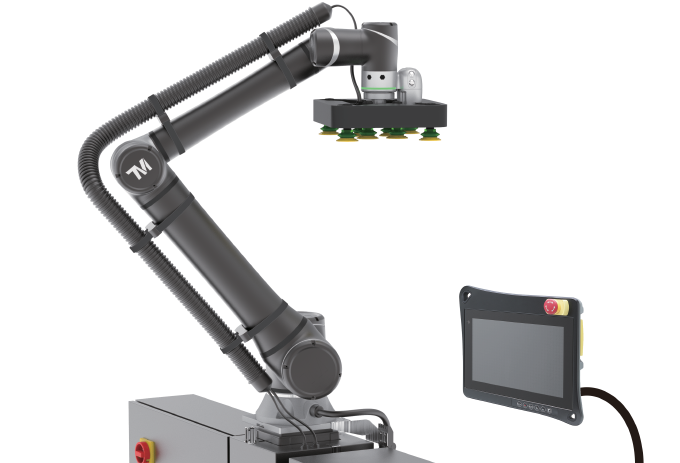
An In-A-Box Palletizing solution is a pre-engineered palletizing solution using a collaborative robot (cobot). It represents a standardized, "cookie-cutter" approach to automation in palletizing tasks. The cobot-based system typically includes preconfigured software and hardware components, making it relatively easy to implement in diverse settings. However, this one-size-fits-all approach can quickly reach its limits in more demanding, complex or specialized applications.
When deciding between custom engineered and pre-engineered solutions, manufacturers must weigh the uniqueness of their operational requirements against budget constraints, implementation timeframes, and long-term scalability needs.
|
CUSTOM ENGINEERED Seamless Integration Long lead times Vendor Lock-In Specialized maintenance Scope Creep can impact ROI |
|
|
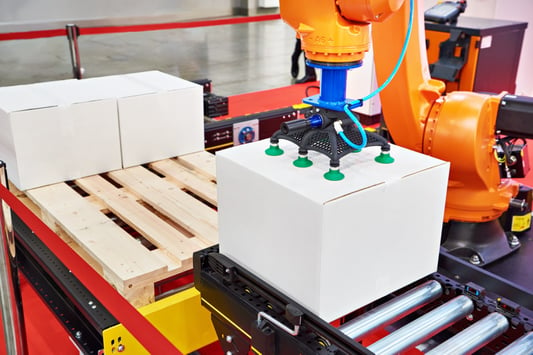
PRE-ENGINEERED Quicker implementation Reliable with easier maintenance Most requirements are met with the standard product, the remainder with customized elements or compromises. Less adaptable |
 |
|
IN-A-BOX Quick and easy implementation with pre-configured software and hardware. Cobots are easy to learn & operate One-size-fits-all approach limits performance Not adaptable |
 |
Lean Palletizing solutions
LEAN PALLETIZING
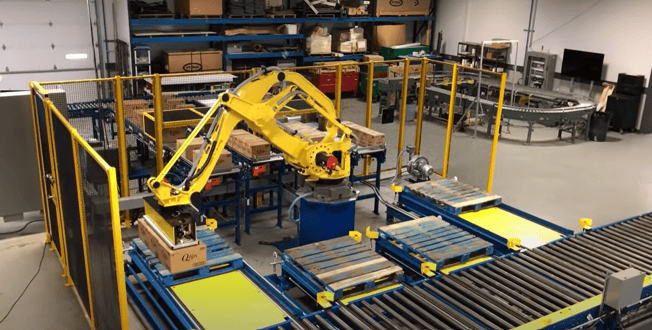
Lean Palletizing is built and operates using lean manufacturing principles. Contrary to the other methods for which the supplier or technology dictates how you need to adapt your layout or material flow, this approach supports your factory floor's continuous improvement efforts.
It leverages collaborative robots’ builtin functions, intrinsic simplicity, and the possibility to integrate them seamlessly into existing layouts, keeping the operators in mind.
Contrary to the In-A-Box Solutions that sacrifice performance, this solution category offers reliability, and interoperability for quick deployment, advanced control software, flexible tooling, and a user-friendly setup interface.
Moreover, Lean Palletizing:
• Optimizes the material flow at the cell.
• Ensures pallet integrity.
• Allows you to keep improving it and adding new products over time.
It provides a production-ready palletizing cell (PAL Ready) and a modular approach (PAL Series). Both are using standard elements (like end-of-arm tooling, infeed, slip sheet rack, etc.) to allow for efficient deployment, while keeping enough flexibility to deal with the inevitable particularities of your factory and product.
A crucial part of investing in an automated palletizing solution is the cost information. The following section provides insights into the factors that impact pricing. These are the types of questions that are asked before obtaining internal approval.
When evaluating the cost of a palletizing system, it's important to take a comprehensive approach. Compare the initial investment, ongoing operating expenses, and the costs associated with making adjustments or scaling the system.
It is also essential to consider how the initial choice may introduce dependencies that could affect cost flexibility.
Let’s begin with the critical cost components of an automated palletizing solution:
• Initial investment
• Operating
• Training
• Downtime
Initial investment
There are many factors to consider with the initial automated palletizing solution investment.
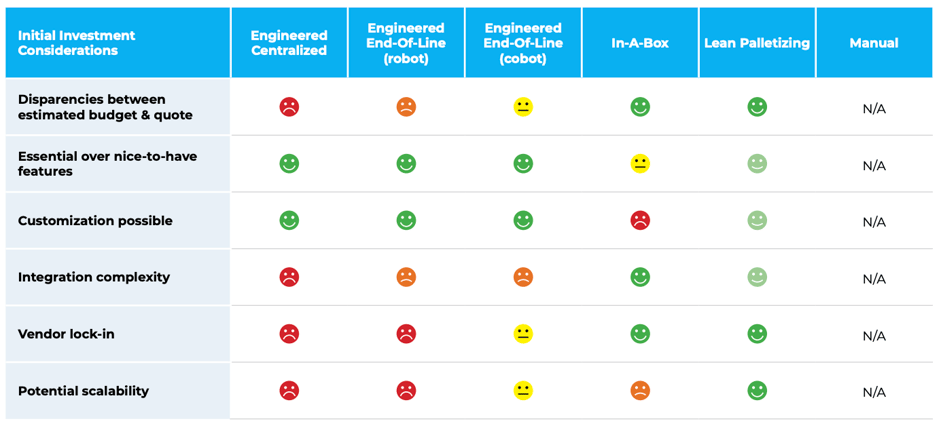
BUDGET PRICING VS. QUOTED PRICING
Make a clear distinction between estimated (budgetary costs) and specific price quotes. This approach is crucial to ensure a fair and accurate comparison of each alternative. Take note of the vendor’s recommended budget contingency or the extra room they recommend as a precautionary measure to accommodate additional costs.
ESSENTIAL VS. NICE-TO-HAVE FEATURES
Using the Detailed Specification as a reference, essential and “nice-to-have” features should be clear. Make your own list before receiving your quotes. When a quote is received, crucial features of the specific use case should be highlighted, while the superfluous ones should be struck out. If necessary, ask the vendor to provide a new quote to remove any unnecessary features.
INTEGRATION
Certain automated palletizing solutions may require more substantial (and perhaps intricate) integration efforts. The level to which a solution aligns with the existing factory processes, layout, and systems is important to understand. Here are questions to ask the vendor to help kick start that discussion:
• Will the chosen platform allow you to automate other stations in your factory or in sister companies?
• How well does the solution accommodate our current factory layout?
• What level of compatibility does the solution have with our existing systems?
• How extensive are the integration efforts?
• Are there any prerequisites or modifications needed in our current processes for successful integration?
• Can you provide examples of successful integrations with similar factory setups?
CUSTOMIZATION
If the solution does not cover the essential features required for the palletizing application, there might be additional customization costs. The initial customization costs should be considered, as well as the need for ongoing costof-ownership expenses to maintain the system’s relevance and functionality. This includes additional customization expenses over time as the system evolves and remains in operation. Referring to the Detailed Specifications, expenses associated with each customization to incorporate the essential features should be considered.
VENDOR LOCK-IN
When assessing the initial investment, the potential long-term costs and consequences of selecting the vendor must be considered. Vendor lock-in may have an impact on changes, scalability, and other factors. Considering this in the review of the alternatives can affect the cost of ownership portion of the ROI calculation.
SCALABILITY
Finally, it is important to consider the scalability of a solution and how it might influence the cost of ownership. Here are some questions to consider:
• Does this solution require a larger upfront investment but then reduce the costs of subsequent upgrades?
• Does this solution enable a modest investment and offer the possibility to expand as needed?
• Will it be possible to scale the solution and expand its capacity as the requirements evolve?
• What would be the upgrade costs?
The following table outlines the Initial Investment Considerations for each solution type. These are relative representations between each category to help in your decision process.
Operating costs
The operating costs for a robot palletizer can vary significantly depending on several factors:
1. Energy costs: Energy costs depend on system efficiency, runtime, and the local electricity rates.
2. Maintenance and repairs: Regular maintenance and repairs contribute to operating costs. It is important to understand who is authorized to perform maintenance, proposed service contracts, and how spare parts are purchased. If possible, a current customer of the vendor can provide insights from the user's standpoint. The proposed maintenance and support packages offered by the supplier should meet the company’s expectations.
3. Training costs: The cost of training existing and new employees on the system should be compared. Current customers can provide a clear view of the training experience their team received.
4. Programming and software updates: It is important to document software license costs and subscription costs. Equally as important is clarifying the responsibilities for program additions and changes. Can existing employees handle these tasks, or does it involve external individuals?
Unexpected costs are frustrating. Keeping track of all potential expenses increases the likelihood of obtaining a more accurate estimate of the initial investment and operating true costs.
Every type of palletizing solution comes with its unique set of advantages and benefits, accompanied by its own set of drawbacks and risks. Culminating key insights from this guide, the following overview highlights where each solution excels and instances where exercising caution might be prudent.
In this stage, assess the chosen solution(s) to their respective sections below. As each option comes with its own set of drawbacks and risks, it is crucial to verify that all risks can be addressed and mitigated.
Engineered Centralized palletizer
This solution type creates factory challenges such as layout limitations as it acts like a 'monument' within the facility. This establishes a single point of potential failure and restricts modifications. The installation of this customized system demands extensive project planning, coordination, and a significant initial investment. Additionally, the system requires highly skilled operators and specialized maintenance personnel.
|
Distinct benefits and advantages |
• High efficiency for high production rate |
|
Challenges/problems it solves better than its alternatives in the market |
• Higher efficiency |
|
Drawbacks and risks |
• Single point of failure • Very large footprint • Construction project scale • High initial investment • Upgrade ripple effect • Requires expertise to operate • Reduced flexibility • Can be dependant on vendor for adding new products |
|
Risk mitigation option(s) / Plan B |
• Only use highly reliable, proven technologies as the palletizer becomes a single point of failure • Only use this type of palletizer for steady and predictable production • Have a rigorous maintenance program |
Engineered End-Of-Line palletizer (robot)
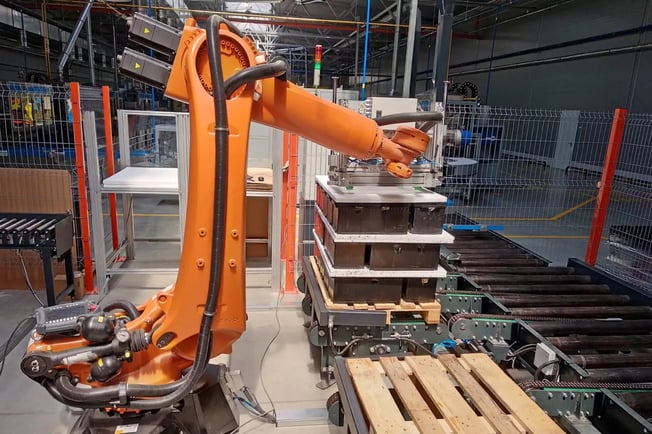
This custom palletizing system often requires a high initial investment and offers limited flexibility in adapting to different tasks. They demand considerable space, adding to the complexity of maintenance and operation. Expertise is essential for their operation, and their limited mobility can be a constraint. Additionally, there is often a dependency on the vendor for integrating new products into the system.
|
Distinct benefits and advantages |
• High efficiency and speed |
|
Challenges/problems it solves better than its alternatives in the market |
• Higher payload and/or higher throughput |
|
Drawbacks and risks |
• High initial investment • Limited flexibility • Space requirements • Maintenance complexity • Requires expertise to operate • Limited mobility • Can be dependant on the vendor for adding new products |
|
Risk mitigation option(s) / Plan B |
• Only use highly reliable, proven technologies as the palletizer becomes a single point of failure • Only use this type of palletizer for steady and predictable production • Have a solid maintenance program |
Engineered End-Of-Line palletizer (cobot)
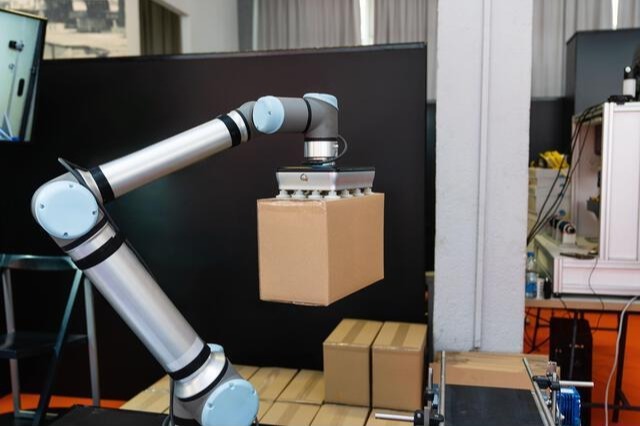
Engineered End-Of-Line cobots offer a small footprint and flexibility include tailored gripper, infeed, and safety features that outperform many alternatives. However, they typically have limited throughput and can only handle limited payloads and pallet height. There is often a dependency on the vendor for extending capabilities and adding new products, which can be a significant limitation. Additionally, as cobots are a more recent and thus less-proven robotics technology, this introduces an element of uncertainty
|
Distinct benefits and advantages |
• Small footprint |
|
Challenges/problems it solves better than its alternatives in the market |
• Small footprint with tailored gripper, infeed, and safety |
|
Drawbacks and risks |
• Limited throughput • Limited pallet height • Dependant on the vendor for extending capabilities • Can be dependant on the vendor for adding new products • Cobots are a more recent (less proven) robotics technology |
|
Risk mitigation option(s) / Plan B |
•Switch back to manual labor if an issue arises (not a single point of failure) |
In-A-Box palletizer
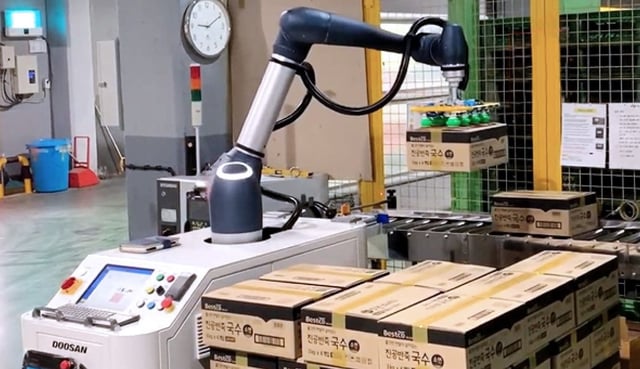
This off-the-shelf palletizing solution provides high mobility, and simple software for adding new products or pallet patterns. However, they have very limited throughput and pallet height capabilities, and cannot perform tasks not pre-programmed in the software, such as handling slip sheets. Their capabilities cannot be extended using traditional automation techniques, and as a more recent and less proven technology, cobots carry inherent uncertainties.
|
Distinct benefits and advantages |
• Small footprint |
|
Challenges/problems it solves better than its alternatives in the market |
• Intra-day mobility from one line to the other |
|
Drawbacks and risks |
• Very limited throughput and pallet height • Cannot perform tasks not considered in the software (e.g. slip sheets) • Capabilities cannot be extended using traditional automation techniques |
|
Risk mitigation option(s) / Plan B |
• Switch back to manual labor if an issue arises (not a single point of failure) • Limit to smaller throughput application (e.g. 6 picks/min) as there is very little levers to optimize performances |
Lean Palletizing
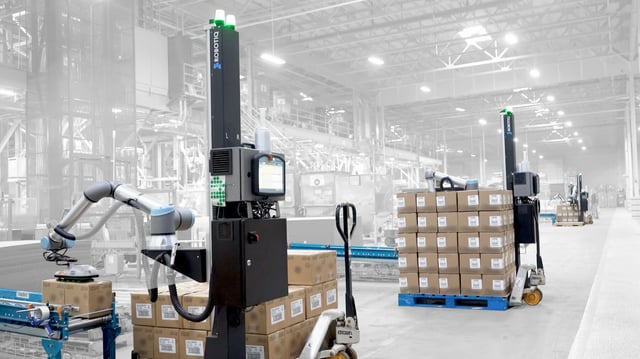
Lean Palletizing is built and operates using lean manufacturing principles. Contrary to the other methods for which the supplier or technology dictates how you need to adapt your layout or material flow, this approach supports your factory floor's continuous improvement efforts.
This palletizing solution addresses challenges that other market alternatives cannot, combining the advantages of a cobot solution with the ability to cover a wider range of applications in terms of throughput, pallet height, and more. It leverages the cobot’s built-in functions, intrinsic simplicity, and the possibility to integrate them seamlessly into existing layouts, keeping the operators in mind. On the other side, they still have some limitations compared to full-scale industrial solutions, particularly in payload and throughput capacities.
|
Distinct benefits and advantages |
• Optimized control algorithm and tooling enables higher capabilities than other cobot solutions |
|
Challenges/problems it solves better than its alternatives in the market |
• Advantages of a cobot solution (smaller footprint, etc.) while covering a wider range of applications |
|
Drawbacks and risks |
• Can be too limited compared to industrial solutions (payload, throughput) • Small lead time advantage disappears if the application is very complex |
|
Risk mitigation option(s) / Plan B |
• Switch back to manual labor if an issue arises (not a single point of failure) |
Manual palletizing
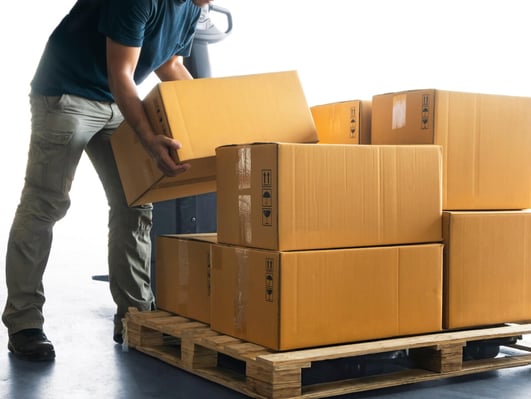
This method is noticeably slower and less consistent than automated methods. Hazards include short-term and long-term health and safety risks. The higher longterm labor costs associated with ongoing manual work may exceed the one-time cost of automation. Moreover, this method is subject to fluctuations and shortages in the labor market. Additionally, manual palletizing may have limited capacity, particularly in handling extremely heavy or oversized products.
|
Distinct benefits and advantages |
• Can adapt to all types of applications |
|
Challenges/problems it solves better than its alternatives in the market |
• Often the only possible solution |
|
Drawbacks and risks |
• Ergonomics issue • Health and safety risks - manual material handling in factories • Higher costs • Labor scarcity - Employee Engagement • Gradual lost of productivity relative to competitors investing in automation |
|
Risk mitigation option(s) / Plan B |
• N/A (status quo) |
Congratulations! You've completed the Automated Palletizing Buyer’s Guide. You now have everything in hand to make an informed decision on an automated palletizing solution.
With a focus on operational excellence and flexibility through the People, Productivity, and Adaptability frames, now is the time to take action and start production faster.
The Lean Robotics approach will lead you through the steps of Design, Integration, and Operation towards innovative yet practical solutions for factories and warehouses.
We look forward to potentially crossing paths for your future robotics needs!


Jump to section
01 Words from our CEO you can’t afford to skip
02 Automated palletizing is a strategic imperative
03 Discovering the palletizing solution landscape
04 The Business Alignment Matrix
05 Palletizing process detailed specifications
09 Identifying drawbacks and risks