
CASE STUDIES
Palletizing Automation for Italian Food Manufacturers | Molino Merano
How an Italian flour producer eliminates manual pallet stacking and improves operator ergonomics with the Robotiq Palletizing Workcell.
Key results
5 days to full installation
From parts delivery to a fully commissioned, running Palletizing Workcell, including assembly, wiring, configuration, and final testing. The Workcell was operational and running product by day five.
Quick payback period
The automation investment paid for itself quickly, a strong return driven by labor savings, increased throughput, and the reallocation of operators to higher-value tasks.
0 additional hires needed
Despite growing production volumes on the line, Molino Merano scaled its palletizing capacity entirely through automation. No new headcount required, and no compromise on output.
Company Overview
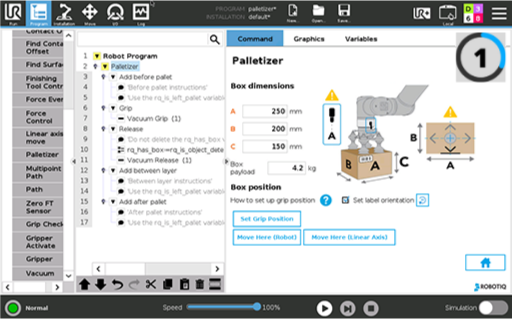
Step 1 - Box dimensions, weight and orientation
About Molino Merano
Molino Merano is a historic Italian flour manufacturer based in Merano, in Trentino-Alto Adige. With approximately 80 employees and year-round production, the company specializes in high-quality flours and a wide variety of grain-based products for both the industrial and retail markets.
Rooted in a tradition of quality and operational excellence, Molino Merano has grown into a leading regional food manufacturer with a commitment to continuous improvement across its production lines. As demand grew, so did the pressure to find smarter, more efficient ways to run its end-of-line operations without compromising the standards its customers expect.
The Challenge
As production volumes increased at Molino Merano, the manual palletizing process at the end of its packaging line became increasingly difficult to sustain. Operators were required to manually lift and place every box onto pallets throughout each shift. A physically demanding task that was creating real operational and human costs.
The key pressures the company faced:
- Production was increasing but labor availability was limited and hard to hire
- Manual palletizing was slowing operations and causing physical strain on operators
- Limited floor space on the production floor made traditional automation solutions impractical
- No room in the existing team for another palletizing operator
What Molino Merano needed was not a lengthy, complex automation project, they needed a practical automation partner that could deliver results fast.
The Solution
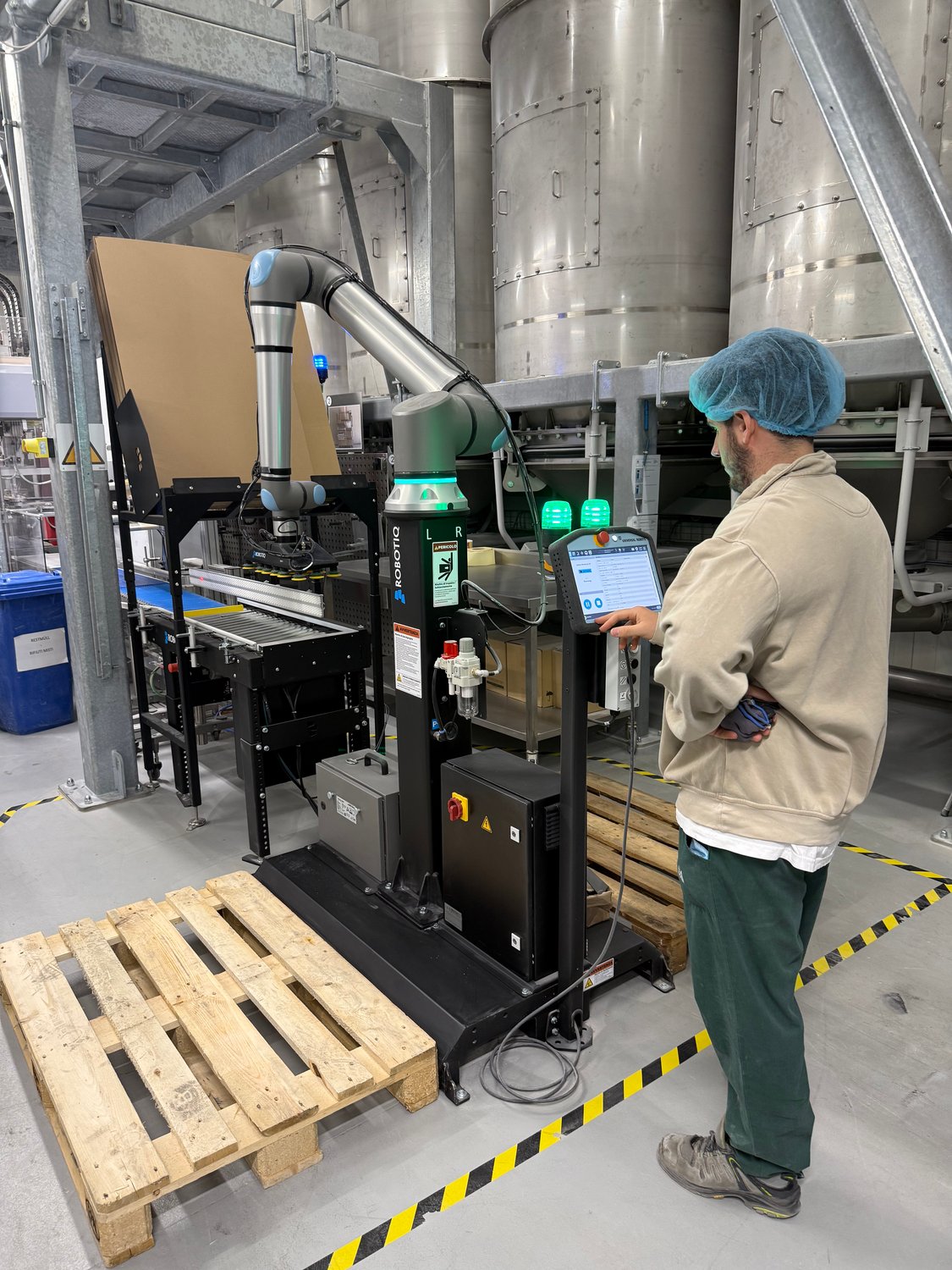
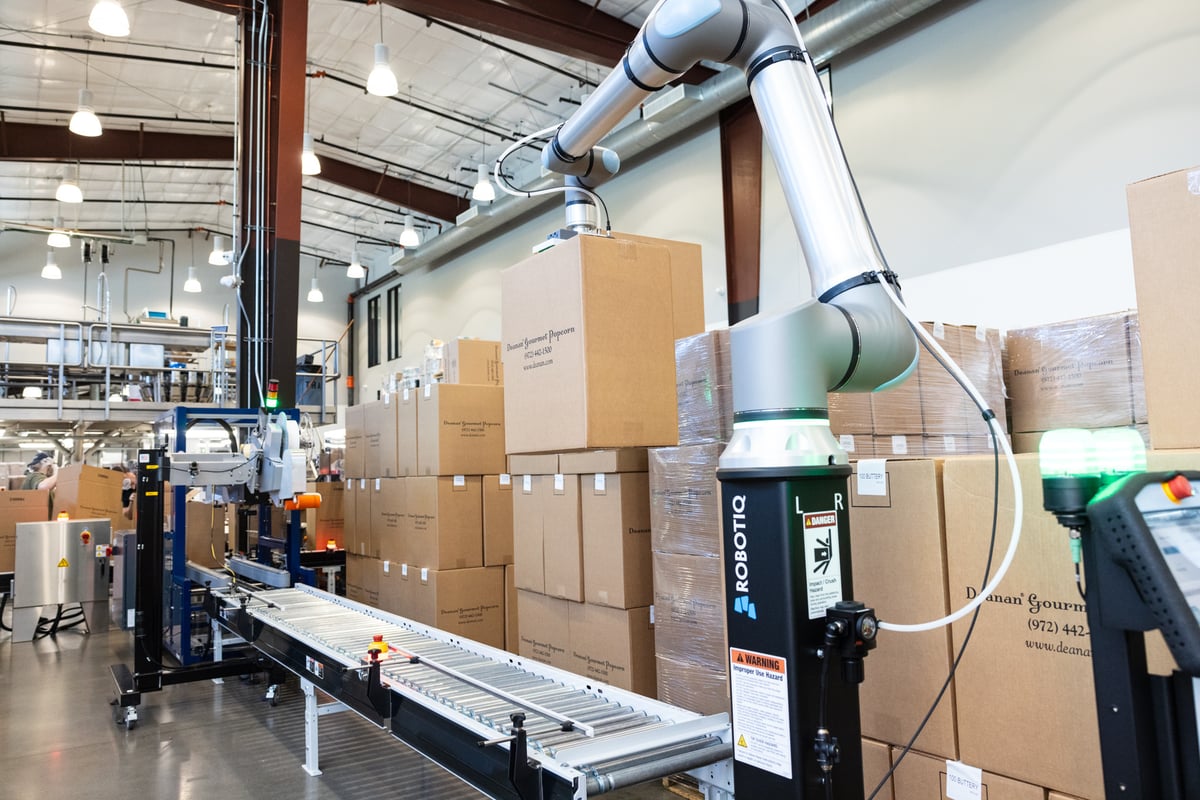
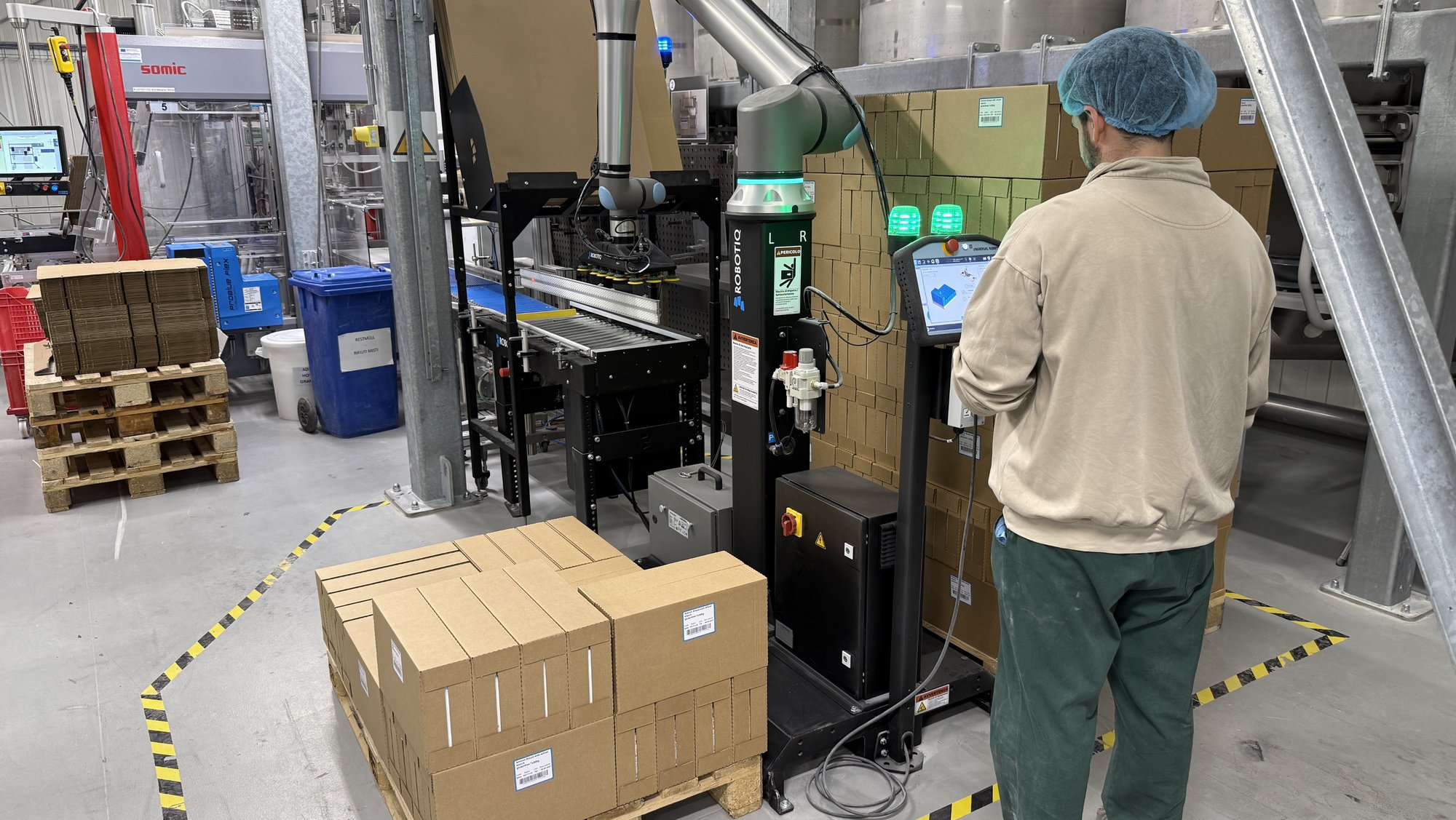
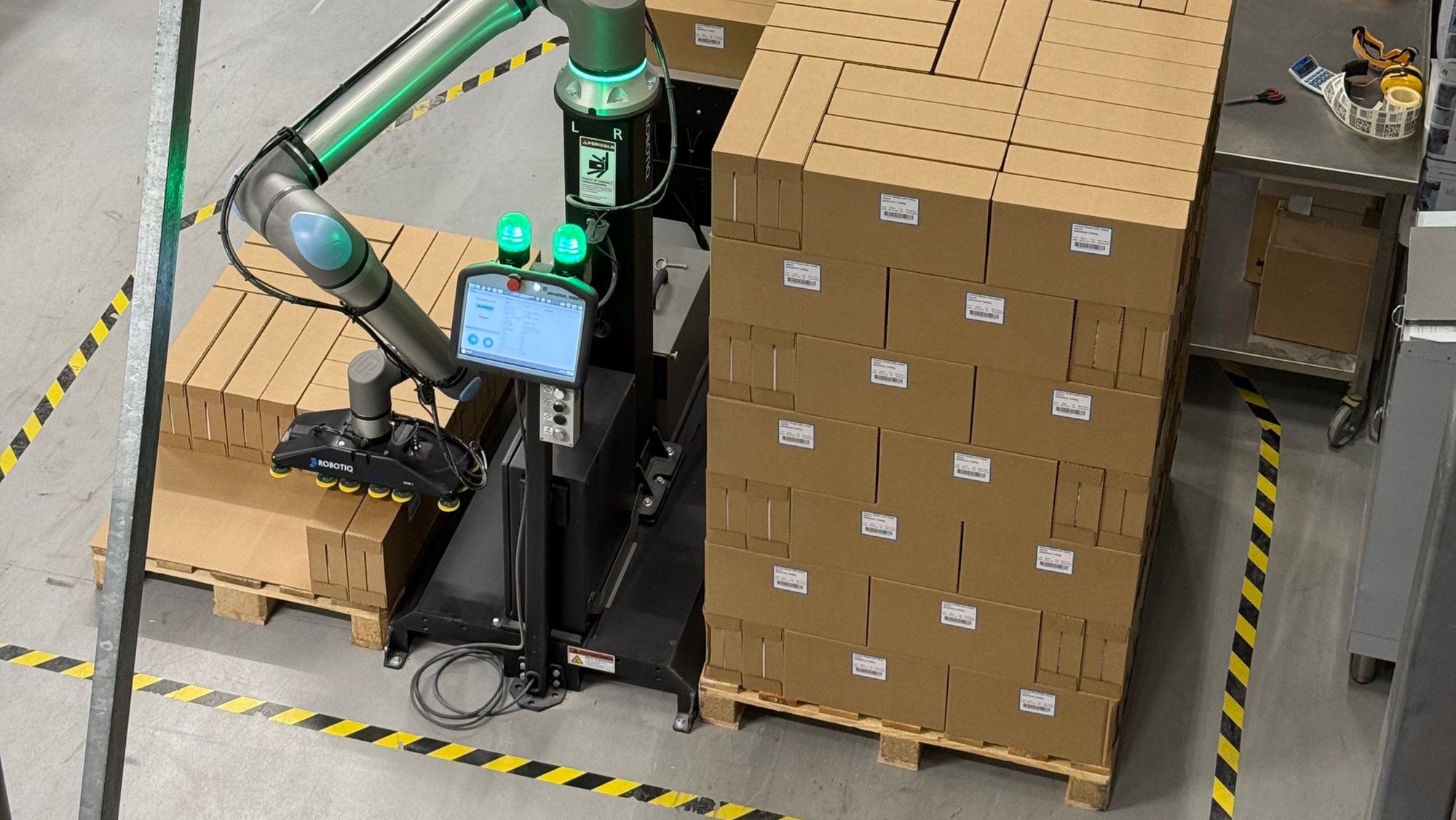
After discovering Robotiq at a trade show, Molino Merano selected the Robotiq Palletizing Workcell (PE20), a collaborative robot-based palletizing solution built for fast deployment and flexibility.
Key requirements that the PE20 addressed:
- Fast deployment, completed in just five days
- Easy operator adoption without specialized robotics training
- Compact footprint to fit within the existing tight production floor layout
- Elimination of repetitive manual lifting that was causing back pain and physical strain on operators
The solution also included a vertical interlayer system and integrated smart infeed, allowing Molino Merano to manage multiple SKUs and optimize the use of vertical space. Operators can change pallets while the Workcell continues palletizing, keeping the line running without interruption.
Why Molino Merano Chose Robotiq
Speed of deployment
From parts delivery to a working Palletizing Workcell in five days. For a food manufacturer where production continuity is critical, that speed was essential.
Compact footprint
The existing plant had tight floor space. The PE20 respected Molino Merano's actual line layout, even within constrained dimensions, with no need for fencing or safety scanners.
Multi-SKU Flexibility
The vertical interlayer system and integrated smart infeed allow the Workcell to handle a large variety of products. A key requirement given Molino Merano's broad product range.
Ease of use
Operators adopted the Workcell quickly with no specialized robotics expertise required. The team can change pallets while palletizing continues, making day-to-day operation straightforward and uninterrupted.
The Robotiq solution
Frequently Asked Questions
How long does it take to install a Palletizing Workcell?
Installation timelines vary by solution, but the Robotiq Palletizing Workcell is designed for fast deployment. Molino Merano went from parts delivery to a fully operational Palletizing Workcell in five days. With assembly, wiring, and commissioning completed in three to four days and final testing on day five. This is significantly faster than traditional industrial automation projects, which can take months to deploy. A key factor in achieving that speed is having the project properly scoped before anything ships. Robotiq's IQ platform validates the Workcell design, including cycle time, reach, pallet configuration, and conveyor layout through simulation before deployment begins, so there are no surprises on installation day.
What is a realistic ROI for end-of-line palletizing automation?
ROI on palletizing automation depends on labor costs, production volumes, and how operators are redeployed after automation. For Molino Merano, the payback period was quick. Achieved through reduced manual labor, increased throughput, and the reallocation of staff to higher-value tasks. Many food manufacturers see ROI within one to two years, making palletizing one of the most financially predictable automation investments available. Robotiq's IQ platform includes a built-in ROI calculator that generates a personalized payback estimate based on your actual inputs so the financial case is confirmed before any commitment is made.
How do you know if robotic palletizing is the right fit for your production line?
The fastest way to find out is through Robotiq's IQ, Fit Check. A five-minute assessment that evaluates whether a palletizing application is viable based on production volumes, labor context, package types, and basic site constraints. It gives a clear answer on whether the business case holds and what the deployment path looks like, filtering out unfit applications early so time and resources go toward projects that are genuinely worth pursuing.
Can a robotic palletizer handle multiple product SKUs?
Yes. Modern collaborative palletizing solutions are built to handle product variety without requiring major hardware changes between runs. The Robotiq Palletizing Workcell used at Molino Merano includes a vertical interlayer system and integrated smart infeed that allow it to manage multiple SKUs efficiently. Pallet patterns and product configurations can also be updated through software, giving manufacturers flexibility as their product lines evolve.
Is robotic palletizing suitable for facilities with limited floor space?
Yes, collaborative palletizing solutions are specifically designed to work within existing plant layouts, including facilities with tight floor space. The Robotiq Palletizing Workcell operates in collaborative mode, which eliminates the need for safety fencing or area scanners, significantly reducing the footprint compared to traditional industrial palletizers. Molino Merano deployed the system on an active production floor with constrained space without requiring structural modifications.
What happens after a Palletizing Workcell is installed? Is ongoing support available?
Absolutely. Post-installation support is a critical part of any successful automation deployment. After deployment at Molino Merano, Robotiq's engineering team worked directly with the customer's maintenance team to fine-tune palletizing trajectories, optimize interlayer placement, and resolve any motion planning adjustments as the solution adapted to real production conditions. Ongoing support ensures the system continues to perform as production requirements evolve.
What are the main benefits of automating end-of-line palletizing in food manufacturing?
Automating end-of-line palletizing in food manufacturing delivers several compounding benefits: it eliminates repetitive manual lifting that causes ergonomic injuries, frees operators for higher-value tasks, removes a bottleneck that limits throughput, and reduces dependence on a labor market that is increasingly difficult to hire from. For manufacturers like Molino Merano, automation also enables production to scale without proportional increases in headcount.
Ready to automate your end-of-line operations?
If your team is still manually stacking pallets at the end of a packaging line, dealing with operator strain, throughput bottlenecks, or difficulty hiring for repetitive physical work, the Robotiq Palletizing Workcell is built to solve exactly that.
Whether you're running a single packaging line or looking to scale automation across multiple lines, Robotiq's team can help you assess your application, model the business case with IQ, and get a deployment-ready solution in front of you, fast.